L&L office
Motherless BrooklynThe L&L office begins as a tightly boarded Bergen Street storefront and becomes the base of Frank Minna’s detective agency, hidden behind the appearance of a car service. Its cramped rooms hold both the practical machinery of the business and, after Minna’s death, the traces by which his former partners try to understand his absence. The office’s transformation—from neglected shop to improvised agency, and then to a workplace arranged around an empty place—makes it one of the novel’s clearest physical records of Minna’s influence.
Setting and Transformation
The storefront stood on Bergen Street, just short of Smith Street, boarded so thoroughly that it resembled a condemned building. Lionel Essrog already knew its interior from an earlier life: it had been a miniature candy store run by an elderly Hispanic woman, with only a rack of comics and magazines. His recollection includes her catching his arm when he tried to leave with a copy of Heavy Metal concealed in his jacket. When Minna brought the boys there, the disused shop became the proposed home of L&L Car Service.
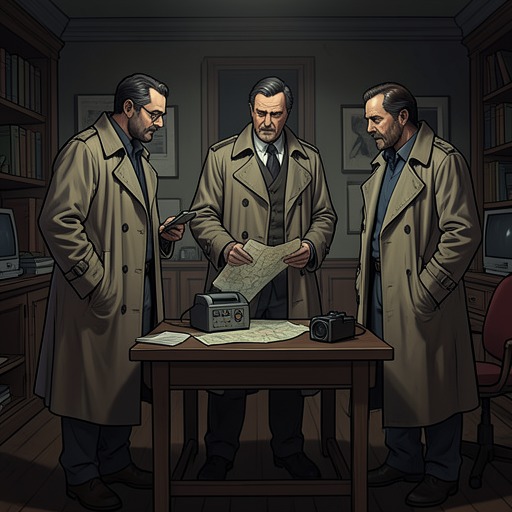
The change of use was immediate in ambition, if not in appearance. The storefront was to be rehabilitated and fitted with radios, office equipment, stationery, telephones, tape recorders, microphones, a television, and a small refrigerator. At that point the fleet consisted only of a purple Cadillac, while additional vehicles were expected. Minna also arranged free driving lessons for the boys through a driving school on Livingston Street. The office therefore marked a practical change in their lives: they were being prepared to drive, handle communications equipment, and work together under Minna’s direction.
Minna eventually disclosed that the car-service identity was a front: L&L was a detective agency. The modest Bergen Street premises thus housed a business whose public appearance and actual purpose did not match. The boys’ work was to involve cars, cameras, tape recorders, and radio communication, but the storefront’s ordinary commercial disguise was part of the arrangement. Its small scale contrasts with the more expansive role Minna assigned to it.
The Agency at Work
Fifteen years after the renovation, the Bergen Street office still has a sharply legible division between public-facing space and work space. A Formica counter separates the waiting area from the rear of the office. On the customer side, a thirty-inch color television plays continuously. Behind the counter are the telephones, file cabinets, and computer, set beneath a large laminated map of Brooklyn.
Minna’s handwritten figures on the map turn the borough into a priced service area. A ride to Brooklyn Heights costs five dollars; Park Slope or Fort Greene, seven; Williamsburg or Borough Park, twelve; Bushwick, seventeen. Airports and Manhattan cost twenty dollars or more. The marked-up map is both a piece of office equipment and evidence of Minna’s habit of making arrangements concrete: neighborhoods become destinations, and distance becomes a number the business can charge. Its prices also give the office a local geography, connecting the small room to the borough beyond it.
The office’s practices extend beyond transport. Minna Men wear suits, drive cars, listen to tapped telephone lines, carry and collect money, answer phones, and pick up packages. They stand behind Minna with their hands in their pockets, imitate his manner, and follow instructions rather than asking questions. This description presents the office not simply as a workplace but as the center of a discipline built around Minna’s example. Its routines are designed to make the boys into a team, even as the statement that Minna is dead exposes the limit of that imitation: the founder cannot be replaced by copying his pose.
Objects and Minna’s Absence
After Minna’s death, the office retains the ordinary signs of his recent presence. The ashtray on the counter is full of cigarette butts he had held; the telephone log bears his handwriting from earlier that day; a sandwich on top of the refrigerator has the marks of his bite. These are not formal keepsakes. They are working-room remnants, and their familiarity makes the gap they surround more immediate. The four surviving men are described as arranged around a missing centerpiece, as though the room’s usual organization has lost its principle.
Lionel’s handling of Minna’s wallet brings that tension into a small, exact action. He takes the bundle of Minna’s business cards and slips them into his pocket, then drops the wallet on the counter and slaps the Formica five times to complete a six-count. The business cards matter as a practical clue to how others might have found them, while the repeated slap belongs to Lionel’s compulsive counting. In the same gesture, the office’s counter becomes a surface for both investigation and ritual: the men are trying to establish what happened, and Lionel imposes a count on a scene that otherwise feels disordered.
The others immediately consider several possible paths by which the police could have located them: Minna may have spoken the initials L and L as he was dying, a business card may have been in his coat, or Gilbert Coney may have given names away. The office is consequently not just where the group gathers after the death; it is where their exposure becomes a question they have to confront. Their former base, with its cards, telephones, and records, links the agency’s ordinary work to the danger now pressing on it.
Neighborhood and Narrative Significance
The office belongs to a Brooklyn shaped by overlapping local arrangements. Minna’s Court Street is governed by familiar businesses, informal obligations, and understandings that need not be stated aloud. The office’s Bergen Street address places the agency within that neighborhood world, while its map translates the borough into routes and fares. Elsewhere, Lionel associates Minna’s haunts with the possibility of imagining him still alive; a nearby newsstand known as the Casino becomes one such place to visit after the death. The storefront and the streets around it preserve Minna through routine, even when routine can no longer restore him.
That rootedness sharpens the contrast with Lionel’s later experience on the Maine coast. There, the open sky and ocean seem to remove the language-filled walls he needs as supports; the coastal space feels unlike the familiar, structured world of Brooklyn. The office belongs to that earlier urban order: a bounded room, divided by a counter, equipped with telephones and files, and connected to a neighborhood through a fare map. It offers no escape from the consequences of Minna’s death, but it gives those consequences a place and a set of objects. As the agency’s operational center and the scene of the survivors’ return, the L&L office holds together Minna’s practical legacy, the boys’ learned routines, and the conspicuous fact that the person who organized them is gone.